Orapa Mine
A deduction game by Junghee Choi and Wanjin Gill, published by Gameology in 2024. This is the digital table: the shared screen holds the mine, and every hunter plays from a phone. Back to the table
What is down there
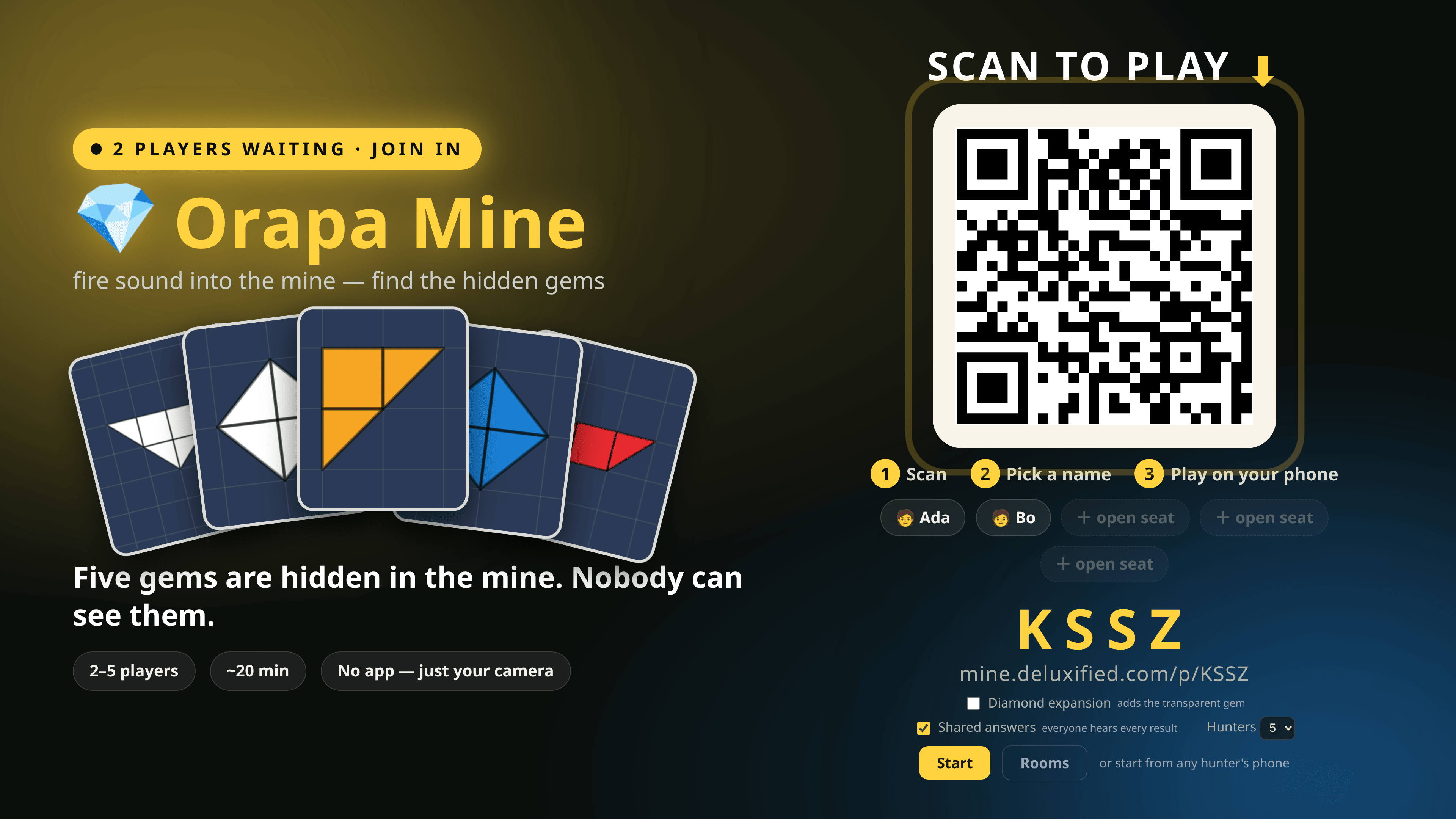
Five minerals lie hidden in a ten-by-eight mine: a red parallelogram, a yellow triangle, a blue diamond, a large white triangle and a white diamond. Everyone knows which five are down there. Nobody knows where.
The server plays the quiz master — it hides the minerals and answers every wave honestly — which is the rulebook's three-player-and-up mode with the machine in that chair. So everyone at the table is a hunter, and nobody has to sit the round out.
A turn
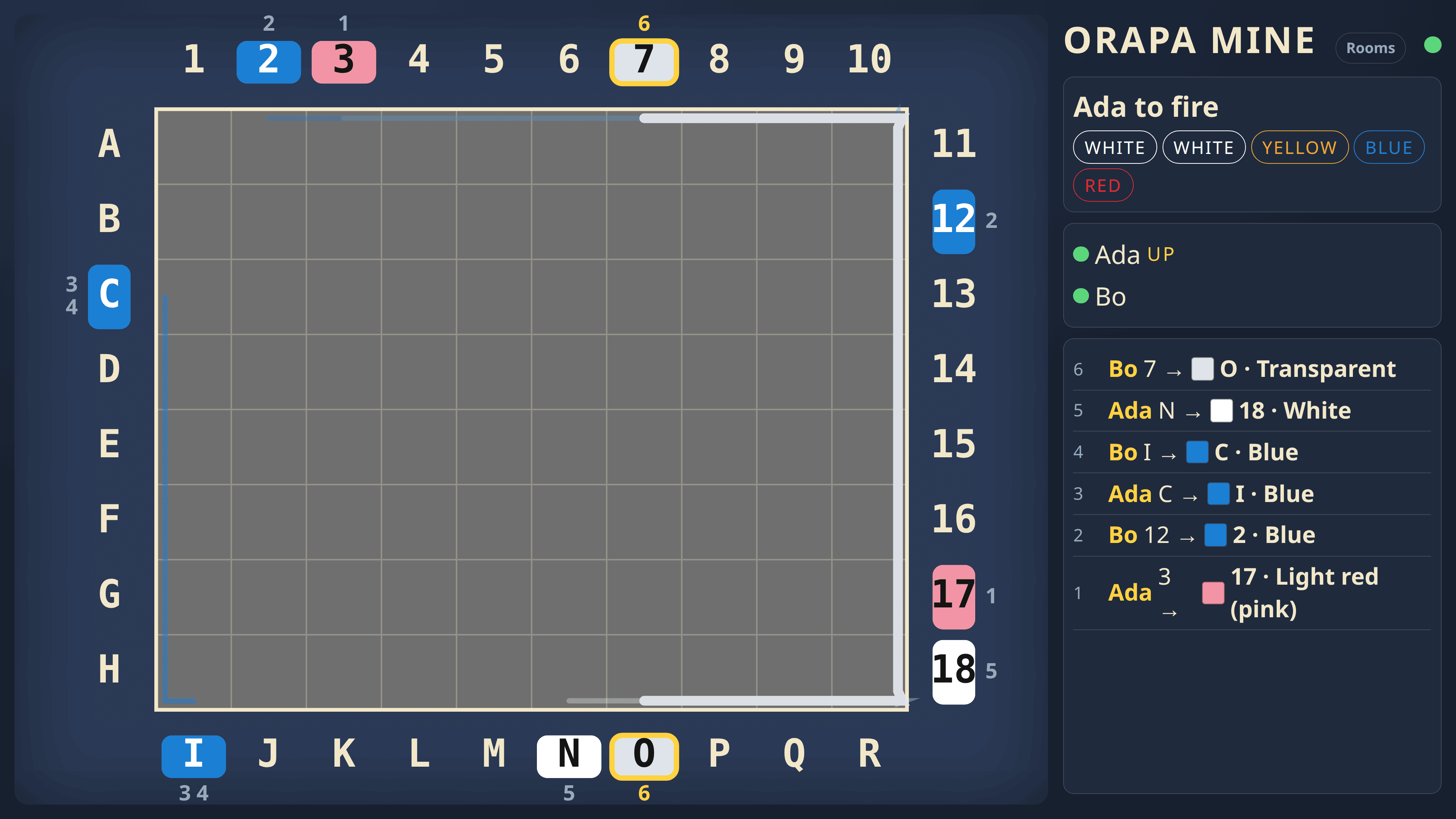
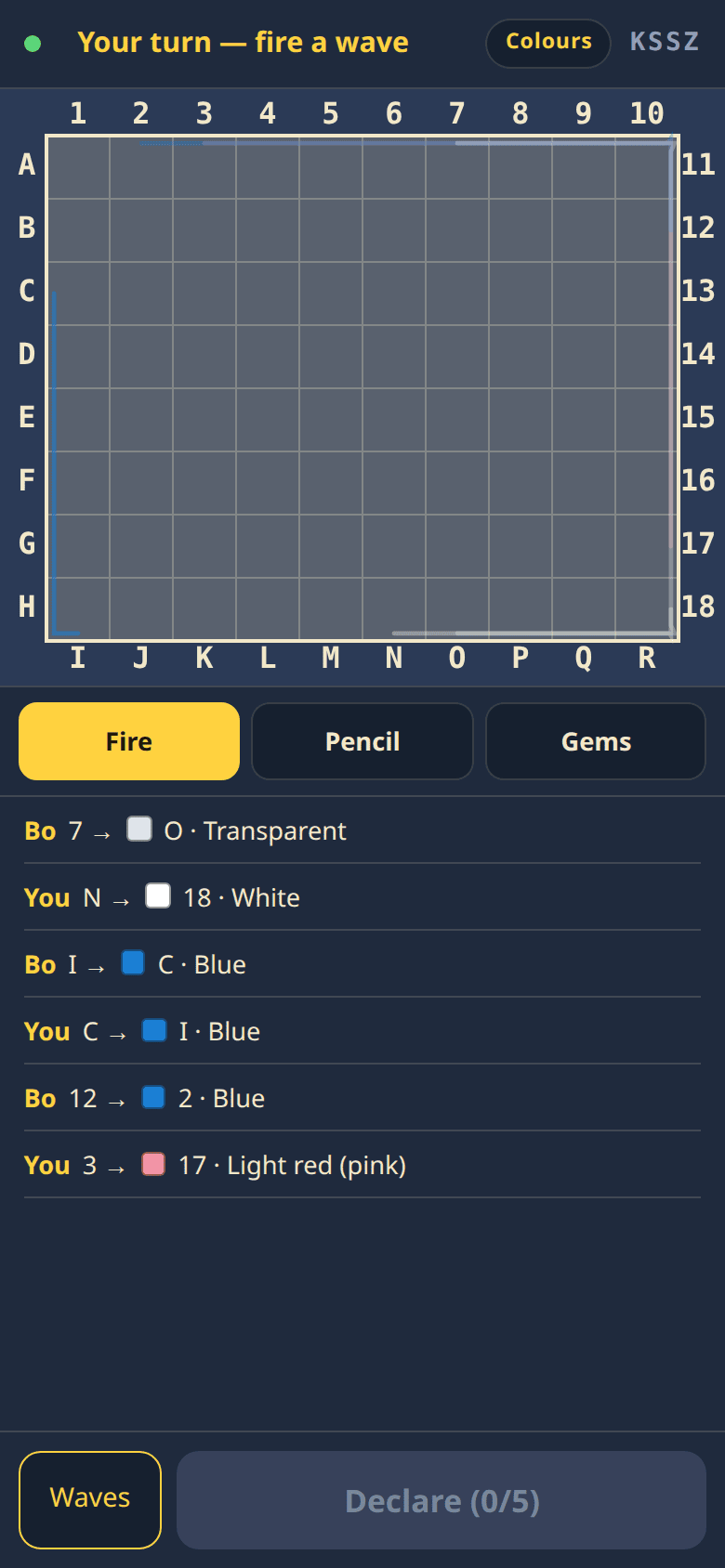
On your turn you fire an ultrasonic wave into one of the 36 ports around the edge. It travels in a straight line, bounces off every mineral it meets, and comes back out somewhere — and where it leaves, and what colour it has picked up, is everything you learn.
Instead of a wave you may ask about a single cell — what is in 4, E? — which also costs your whole turn. It is a narrow question, and usually a wave is worth more.
Reading the colour
A wave picks up the colour of every mineral it touches, and the mixture is the whole puzzle. There are four colours down there — red, yellow, blue and white — and what comes back out is those four mixed together.
One rule makes it tractable: only the first touch of each colour counts. Grazing the red parallelogram twice reads exactly like grazing it once, so a colour tells you whether, never how often. That leaves sixteen possible answers, and each one names a precise set.
| Comes back | The wave touched |
|---|---|
| Transparent | nothing at all |
| Red | red |
| Yellow | yellow |
| Blue | blue |
| White | white |
| Orange | red and yellow |
| Purple | red and blue |
| Green | yellow and blue |
| Black | red, yellow and blue |
| Gray | all four |
White is the fourth primary, not a bystander: it lightens whatever the wave already carries. So red and white comes back light red — the rulebook calls it pink — and red, blue and white comes back light purple. The table screen and your phone both name the colour for you, so you never have to mix it in your head.
Why a light colour is worth more
A plain colour rules one mineral in. A lightened one rules in two at once — the colour and the white — from a single wave, which is why a light purple usually teaches you more than two ordinary shots would.
Declaring
When you think you have all five placed, declare. You get one declaration each — get it wrong and you are out of the round, so a guess made a turn too early costs you the game rather than a turn.
A declaration is scored mineral by mineral: a green ring around each one you placed correctly, a red ring around each one that is somewhere else, and the same verdict in words underneath. First correct declaration wins.
Playing solo
On your own, tap Play solo on the front page (or in an empty lobby). The mine is the same, but the race turns into a score: every wave you fire, and every cell you ask about, adds one. Finish in as few as you can.
- Par is how many waves a computer hunter needed on that exact mine. It always fires the wave it is least sure about and declares the moment only one layout fits what it has seen, so beating it is hard.
- A wrong declaration costs +5 and you keep going. You see the green and red rings, so a wrong sheet still tells you something. That is why it costs more than a wave.
- Give up shows you the mine and ends the hunt.
- Today's mine is one mine a day, the same for everybody, with a board of scores. Your first go of the day is the one that counts. If you lose the connection partway through, open it again with the same name and you carry on from where you stopped.
At this table
- The Diamond expansion adds a transparent gem that bends waves without tinting them — so a trace that leaves in the wrong place having picked up no colour at all is suddenly evidence.
- Shared answers are on by default: every hunter hears every result. Switch it off and you each only learn from your own waves.
- Private rooms. Mark a room 🔒 Private in the lobby and it stays off the public room list, while anyone with the code can still walk in.